
Being Caged
Maya Angelou’s seminal autobiography I Know Why The Caged Bird Sings was a reading that a freshman in Oakland’s public school could not appreciate whole-heartedly, especially if a graded essay followed. “Other things were more important”, she wrote in 1969 in the second sentence of one of the most essential books of culture and history. I remember I got such terrible marks on English papers, too often I would overwhelm my paper with flowery, inaccurate prose, much like arranging a bouquet glutted with bulbous, gaudy shapes or painting an odd composition without a fundamental understanding of values or hues. A common condition of the unpracticed writer is crippled by the heavy abuse of the thesaurus, a tool mistaken for a practical word embellisher and the solution to elegant variation. With material so vivid and decorous, I pursued Angelou’s style with just about every bit of inexperience and lack of sophistication. In other words, I completely lost the plot of Marguerite Johnson, who grew up painfully aware in the racist 1930s American South; aware of her blackness, the female condition, and the instability and suffering of the lives around her, that which further threaten to isolate her from the rest of her forced segregation. In a visit to her home in Stamps, Arkansas in an interview with Bill Moyers, Angelou laid bare the trauma of living to be hated. To confront the ghost that tormented her in the oppressive town, enhancing these old fears.
“But my God what scars does that leave on somebody. I wouldn’t—I don’t even dare examine it myself and when I reached for the pen… To write, I have to scrape it across those scars to sharpen that point. - Creativity, 1982”
Angelou bears this pain through her poetry, and she has woven her story with the same materials she finds moving in her novel; the same line-work that inspired the naive artist with failing English papers. Quoting Shakespeare and Poe, Angelou calls it “musically” prompting, but without figures apart from these white men she felt much in “disgrace with fortune”. It is the repetition of arranging the right words and crafting tone that shifts innocence into knowledge, even marred by pain, and precise control of the ego and awareness that has framed her life that makes Angelou an incredible woman of powerful perserverance; reflected in the thoughtful dedication as a writer and poet. Young women, black girls in particular, are displaced by societal expectations of beauty in all manners of direct and indirect exposure. Adding layers of her displacement when Marguerite is raped at seven years old, she convinces herself it was her fault and becomes mute for years. It is when she is encouraged by a sophisticated black woman named Mrs. Flowers to recite poetry aloud that she is allowed to look into a mirror and see a similar reflection, one that also likes her for being herself: Marguerite Johnson. It is also through the friendly provocation of civil rights activist James Baldwin, another black writer she respected and identified with, that Angelou came to write I Know Why The Caged Bird Sings. Before publication, Baldwin lauded the novel for its bravery—Caged Bird “liberates the reader into life simply because Maya Angelou confronts her own life with such a moving wonder, such a luminous dignity”. To write her memoir in a humble delicacy of her raw assault as a vulnerable child requires painstaking craft and the poignancy written into conditions of segregation across the novel are all her scars being scraped over again, to sharpen the pen… Angelou frees herself of the indignation fostered by the racist conditions she was raised in; the caged bird sings to face the past afflictions by bringing an immense awareness of life and death, tugged by love and hate and endured with poise that shaped her identity. Angelou’s writing is what empowers her—“transcending the pit”, she says in her hometown with Moyers—and others that resonate with the book from the value of writing and the power of black voices.
Toni Morrison, author of 1970 breakout debut The Bluest Eye parallels misogynoir and welcomes labels like “black writer”. In a 2015 interview about her final novel, the eleventh among other masterpieces such as Beloved, she is “‘writing for black people,’ she says, ‘in the same way that Tolstoy was not writing for me, a 14-year-old coloured girl from Lorain, Ohio. I don’t have to apologise or consider myself limited because I don’t [write about white people] - which is absolutely not true, there are lots of white people in my books. The point is not having the white critic sit on your shoulder and approve it” - she refers to writer James Baldwin talking about ‘a little white man deep inside all of us’.” If the predominant voice in all of us are male and Caucausian when fifty percent of the population are woman-bodied and more than half live on the continent of Asia, it stands to provide potent idiosyncrasies and develop reassessments of our values and language rigorously.
I happened to write about Angelou writing this book arising from a great interest of all voices writing about accomplishments over the human condition between active genocide, slavery, discrimination and prejudice that scourge society. My privilege and breadth in reading both Shakespeare and Angelou, Poe and Morrison, Tolstoy and Baldwin at a young age dispense me with rich topics of classic literature. Lately, I hadn’t been turning out a substantial word count—telling myself it was just for the sake of practicing writing, but the indecision, or the ironic freedom of choice, paralyzed me. The deliberation of each word, occasionally conjured from the thesaurus that both Angelou and I wield as writers, is representation of freedom itself, extended by the degrees of talent to tell stories or write essays, the sine qua non of understanding and thereby emerge from the challenge of expressing the complexity of identity encompassing gender and race and the consciousness that compels us from being caged by bodies with effective creativity. In the practice of writing, the identity is granted greater freedom to hone the voices that we can choose to define us.
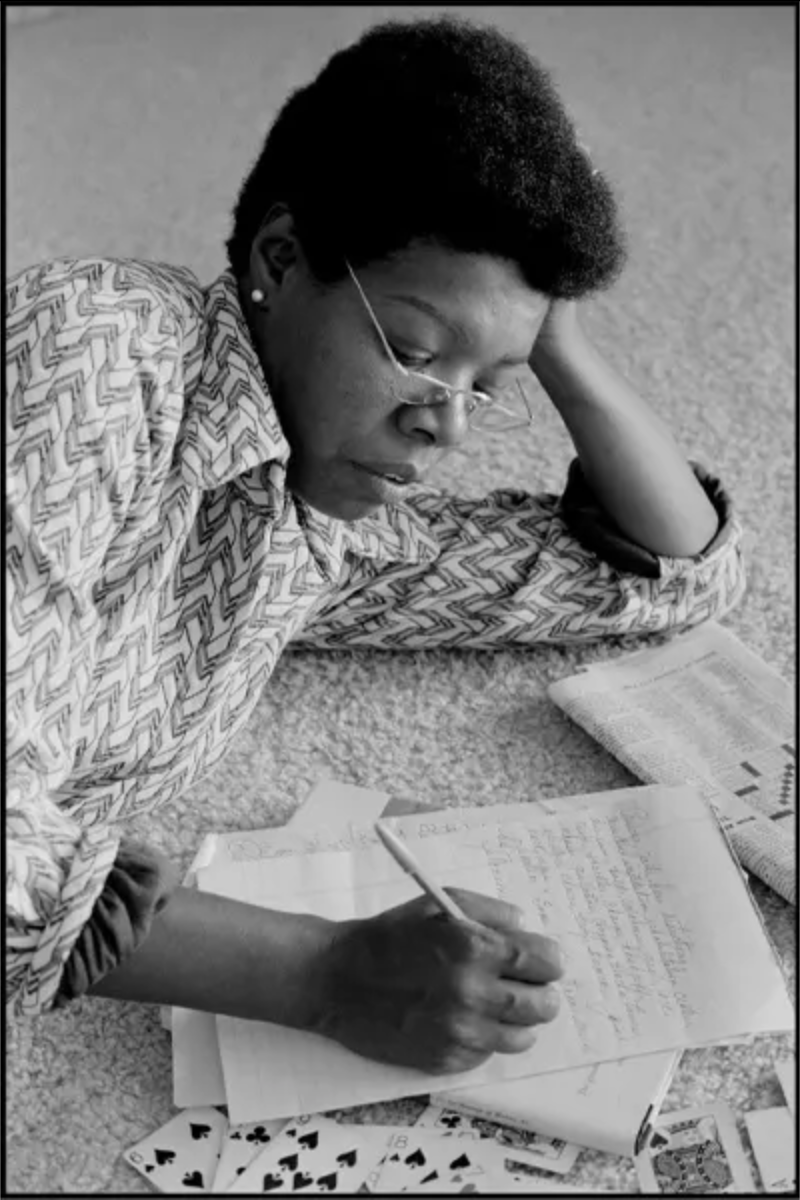 Angelou, with a deck of cards, crossword puzzle, a Bible, a dictionary, a bottle of sherry, and of course, a thesaurus! Photographed by Wayne Miller in 1974.
literature poetry philosophy