
On the Nature of Things: Brownian Motion
De Rerum Natura, a didactic poem written by the Roman philosopher Lucretius is one of the earliest postulates for atomic theory. It was written over two thousand years ago to no more than ease ancient Greece’s suffering under the basis of Epicurean principles. Until nearly the last century, we archaically answered the question of “what are we made out of?” Today, we verifiably consider atoms as the building blocks of all matter, but the first Greek atomists such as Leucippus, Democritus, and Lucretius were overshadowed by the dominating philosophies of Plato and Aristotle, who both rejected this explanation and focused primarily on the principles of order (a similar idea called paramanu was practiced by Kanada of the Vaiśeșika school, in ancient India). Atomism remained widely a philosophical analysis of the world—for as far as biological optics go, mammals are limited to photon detection. If we cannot see these particles how do we know it to be the truth about nature? At the turn of the 19th century, an English teacher named John Dalton published the weights of various elements in A New System of Chemical Philosophy and refined atomic theory. The general tenets of his seminal theory were almost faithful; Dalton simultaneously substantiates Proust’s law and introduces the chemical system we use to form molecular compounds, yet the scientific community remained unconvinced. Dalton’s applications and recorded masses lept atomism one energy level from a belief to scientific theory. Pedesis! In 1828, a botanist named Robert Brown published a pamphlet, A Brief Account of Microscopical Observations…, detailing his work on pollen particles floating in water. From his observations the pollen wiggled about—Brown described this behavior as countless “random walks” that may predict the path or position of the particulate suspended in a fluid or gas at thermal equilibrium. Amongst the physicists, it’s called the drunkard’s walk for taking several steps but hardly successfully getting anywhere. The stochastic phenomenon of motion in your coffee, Lucretius’s sunlit dust, pollutants in the air, the diffusion of the calcium in bones characterizes some incredible processes and natural wonders like sunlight itself. Photons from the Sun could take up to anywhere from 10,000 to 170,000 years to travel from the core from nuclear fusion to the surface of the Earth. With any luck, a photon flows out into the vacuum of space where it takes only 8 minutes per Astronomical Unit to facilitate daytime. Photon behavior, however, is largely different, and thus must be described differently as quanta of electromagnetic radiation observations. Indeed, the underlying mechanics of light itself, its wave-particle duality, fosters vague intuition about our reality.
Although this random mathematical model pervades us everywhere, it took none other than Albert Einstein who published his paper in 1905 to develop a formulaic description of Brownian motion (at the same time he was developing the photoelectric effect, general relativity theory, and likely many other projects). Einstein’s quantitative statistical analysis measured Avogrado’s number and determined the size of these molecules into two parts of increasingly unique solutions. The first part involves studying many random walk simulations and measuring the displacement. Observing any particular particle individually may not be statistically meaningful, but Einstein saw a pattern emerge for a large, almost indiscriminating sample set where the N number of “steps” taken by a walker is proportional to the spread of displacement. A histogram of these walks reveals a Gaussian distribution centered on zero displacement, so we would have an expectation value of zero. Einstein determined that the mean square displacement increases with the number of steps and time in a normal distribution. He continued to further apply interdisciplinary theory to determine the coefficient of diffusion that could be expressed in familiar scaling through thermodynamics to calculate the number of atoms in one mole of a solution. If you remember anything about high school chemistry, maybe it was that Avogadro’s number is an exponent with two digits: a huge number. Einstein’s approach, honed by studying years of other models, allowed him to utilize the Ideal Gas Law as his locus and apply several ingenious methods to count the invisible world. A few years later, Jean Baptiste Perrin is awarded the 1926 Nobel Prize in Physics for confirming Einstein’s theories on Brownian motion and his calculation of Avogadro’s constant that we use today. At last, the existence of atoms and molecules through these inquisitive periods of observing influenced modern science as well as the coincident birth of quantum physics between 1900 to 1930.
I find Brownian motion one of the most fascinating, yet seemingly unremarkable phenomena that dictates nature’s laws. An examination of the history of atomism reveals the remarkable curiosity across philosophers, spiritualists, teachers, botanists, chemists, physicists, and those driven by a desire to understand the mechanics of the universe and very building block of all matter. Furthermore, I feel that it’s significant to acknowledge that it was only in the last one hundred years that civilization had universally adopted the atomic model. When I studied physics before the pandemic, we were made to understand that nowadays many physical processes, even the “invisible” processes could be well-explained. Our outstanding understanding of viruses and their behavior allowed scientists to address a global concern, yet many medical concerns continue to ail and evade our practical solutions. Only just a few weeks ago, an article published in Nature and a dissection led by Harvard Medical researchers of giant viruses may necessitate a reassessment to our biological definition of eukaryotic life. Before our eyes are all the permutations of humankind’s struggle to understand our place amongst the atoms. The future of science remains dynamic yet fragile; dependent on our propensity to continuously challenge our beliefs and collaboration of ideas across disciplines, nations, and time in the chaos of it all.
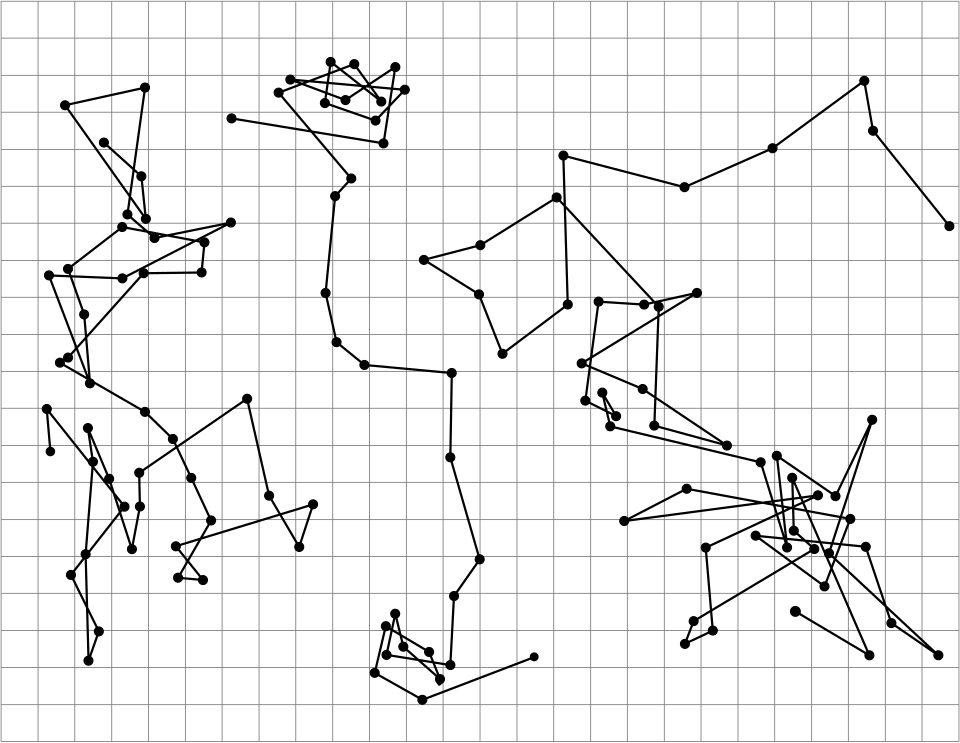
Reproduced from the Jean Baptiste Perrin book Les Atomes: tracings of the motions of three colloidal particles, as seen under the microscope. Courtesy of Wikipedia Commons.
science philosophy nature history