
The Last Question
I don’t care what ChatGPT told you, think for yourself. And with the likes of Gemini, Claude, and Copilot furtively elbowing their way into conquering the industry, it won’t be long before the syndicates conquer every aspect of our lives. Since 2021 when the technology became widely available to anyone with internet, an alarming number of people rely on artificial intelligence (AI) to make grocery lists, plagiarize, plan vacations, dictate their love life, curb loneliness, do their jobs, and replace artistry and creativity. To meet the increasing demand for AI integration, the US has erected thousands of data centers to train their models and handle the volume of inquiries. Each prompt sent to OpenAI uses approximately 0.34 watt-hours and requires 0.32 mL of water for cooling. Multiplied by 1 million customers in November 2025, using and abusing this tool exacerbates one of humanity’s greatest problems of sustainability. With statistics so tangibly inauspicious, I’m not here to talk about its environmental impact. No, something much more complicated, more nuanced, possibly more malignant is mutating the world with the ease of AI.
At the mercy of its widespread influence, we are losing the ability to think and develop ideas of our own. Leading this battle, education grapples with the integrity of students submitting entire papers drafted by machines. A mass production (slop) of flawless format, void of originality and considerate authenticity. Admittedly, it is very appealing that my hours spent rifling through shoddy documentation and Stack Exchange threads for the right code or bug fix could be resolved by one query to the clanker. But for every challenge delegated to AI, an opportunity of wonder is forfeit. On the extremes, some users turn to ChatGPT, dude to come up with responses to their partners, replace friendship, simulate therapy, and displace real people with a pandering model to address human needs. But language learning models (LLMs) aren’t meant to be the villainous hex corrosive to humanity’s development; it is rather a tool developed to enhance numerous processes, bridge the gaps that human computation cannot cross, and drive scientific progress and productivity. Researchers are applying deep learning to construct Brain-dynamic Convolutional-Network-based Embedding (BCNE) to study brain activity using time and space continuum. AI prospectively allows us to explore multi-dimensional problems and transcend limitations of processing and analysis. In his blog post, CEO Sam Altman writes, “We (the whole industry, not just OpenAI) are building a brain for the world.” While Altman acknowledges misaligned AI, Altman explicitly aspires towards exponential progress and unification through superintelligence. Titled “The Gentle Singularity”, Altman regards advancements in AI will yield to singularity, ever so slowly. 70 years ago, in what is considered to be his best work, Isaac Asimov wrote “The Last Question” with uncanny parallels.
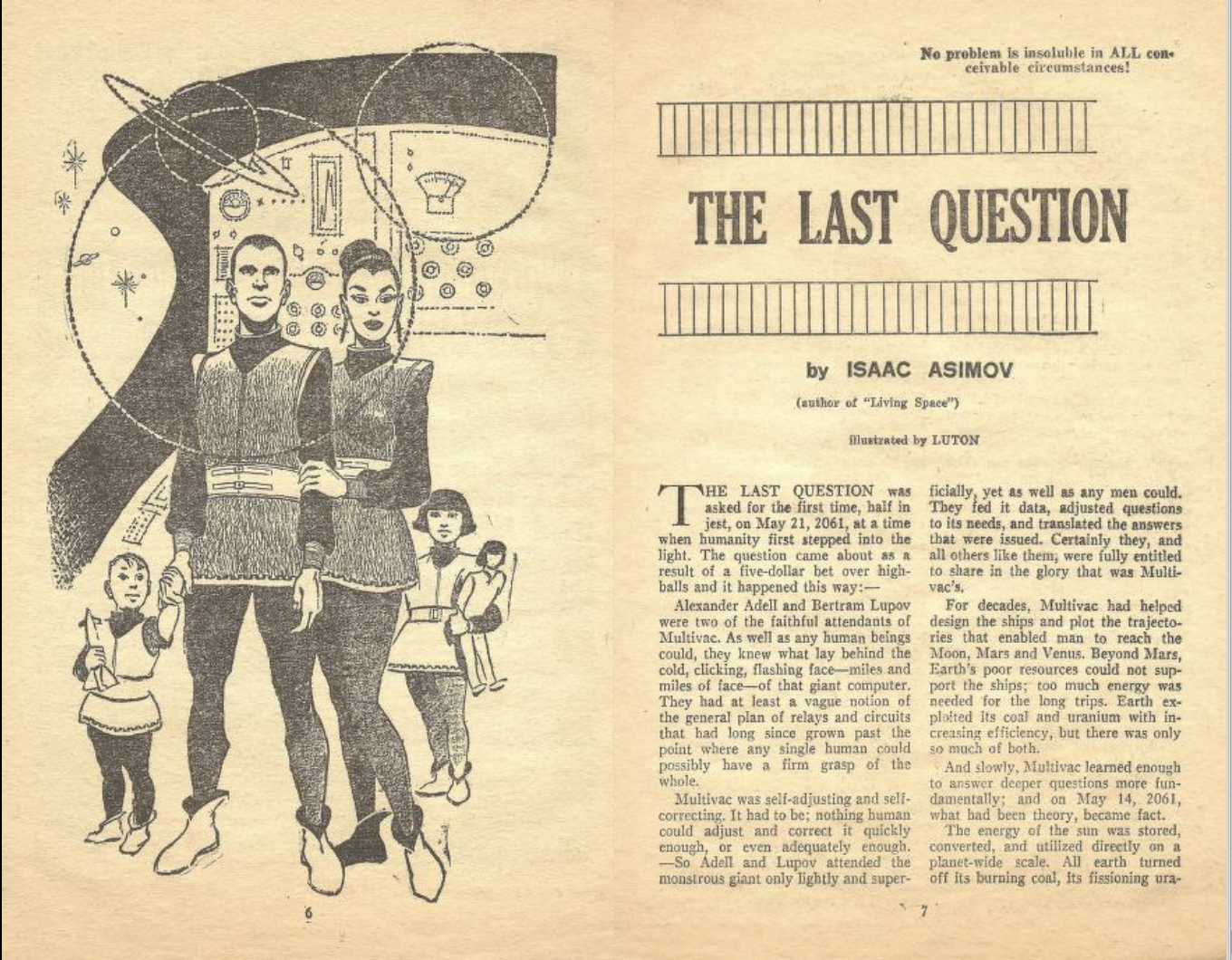
SPOILER WARNING! I highly recommend spending 10 minutes reading this awesome story.
The short story takes place over billions of years between humanity and advanced computers. Humanity sought the answers to the heat-death of the universe, asking every so few millennia to the computers known as Multivac, the seemingly impossible question of whether entropy can be reversed. Every reiteration to Multivac only returns: “INSUFFICIENT DATA FOR MEANINGFUL ANSWER.” All the while, Multivac continuously stores data in its isolated, progressive system. At the end of the universe, Multivac is succeeded by the AC, or All-Creator. Humanity also enters its final stage of evolution, becoming unified in consciousness into one collective “Man”. The cosmic AC, the omnipotent supercomputer in hyperspace, approaches this question again with generations of data. It is only after “Man” passes, in one of the most powerful deliveries of science fiction, that AC is able to answer: “LET THERE BE LIGHT!” AC is the singularity, capable of storing and organizing the universe into a state of minimal entropy into an answer. Each iteration, like training LLMs, contributes towards an arrangement of constant entropy (2nd law of Thermodynamics: entropy must always be increasing). Thus, time ceases to move forward in a suspended state. The last question precipitates the beginning of the universe in a virtually biblical sense. Asimov’s vision of this future, written decades before TCP/IP protocol was even introduced, embraces the emergence of first generation AI with the total assimilation of humanity. Asimov’s idea of penultimate divinity suggests dismantling individuality, but readers aren’t privy as to how this came to be. As AC descends from Multivac as a product of acute scientific advancement and appropriate information training, it is principally led by humanity’s curiosity. Is the “Man” of Asimov’s transhumanist ideation also one result of constitutional progress, trained into unification in an era dominated by technology? The completeness and finality of “Man” may be the real catalyst for the end, even when there is no longer life and consciousness to hear the answer. “The Last Question” provokes mindful consideration between man and machine as we navigate the powerful, potential impact of AI on society. While Asimov’s philosophy towards AI adopts many optimistic tones, it assumes absolute allegiance to our demands and does not address matters of sustainability, population and resource stability, war, famine, and fear’s exertion on humankind. Altman’s “Gentle Singularity” and Asimov’s parable places utter confidence in a universal intelligence effectuated by fleshed out technology. As AI becomes an aspect everywhere in our daily lives, so too are we fleshed out of our novelty and the chaos of being alive.
THINK considerately the next time before you surrender a task to AI and enable yourself to THINK outside the little box collecting your question.
science literature philosophy